Category: Uncategorized

  • Rug Pile Height and Construction: How to Choose the Right Rug for Each Room

    Rug Pile Height and Construction: How to Choose the Right Rug for Each Room

    The size and color of a custom area rug are the decisions people agonize over, but they are rarely the ones that determine whether the rug still looks good in three years. That is settled earlier, by two quieter choices: how tall the pile is and how the rug is constructed. Get those right for the room and the rug wears evenly, cleans easily, and holds its shape. Get them wrong and a beautiful design ends up matted flat in a doorway or shedding onto a bedroom floor. This guide is organized around the rooms you are actually buying for, so you can work backward from the space to the specification.

    Start with pile height, because traffic decides it

    Pile height is the length of the fibers standing up from the rug’s backing, and it is the single best predictor of how a rug handles foot traffic. The common bands are straightforward. Low pile, roughly a quarter inch or less, includes flatweaves with almost no pile at all. Medium pile sits in the quarter-inch to half-inch range. High or plush pile runs above half an inch and is where the deep, soft-underfoot rugs live. Some guides skip the middle category and simply split rugs at the half-inch mark, which is a reasonable shorthand.
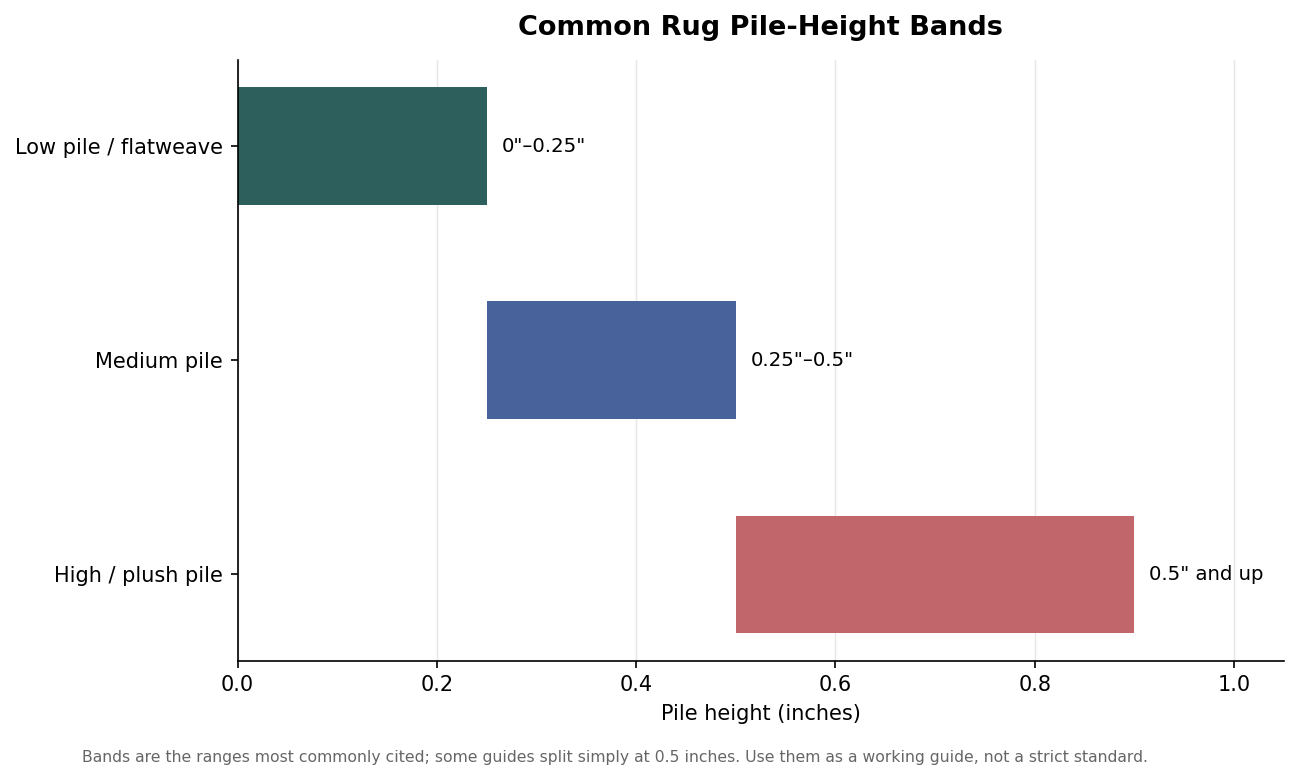
    Horizontal range chart showing low, medium, and high pile height bands in inches
    The common pile-height bands, from near-flat weaves to deep plush.

    The reason traffic decides this is mechanical. Tall fibers crush under repeated footfall and trap grit down at the base where a vacuum struggles to reach, so a plush rug in a hallway looks tired quickly and is harder to clean. A low pile has nowhere for dirt to hide, resists crushing, and vacuums clean in a pass. That is why hallways, entries, kitchens, and dining rooms almost always want low pile, while a bedroom, where the traffic is light and bare feet appreciate the cushioning, is the natural home for plush. Dining rooms deserve a special mention: chairs slide in and out over the same spots constantly, and a low pile lets them move without catching or wearing a track.

    Construction is what actually survives the wear

    Pile height tells you how a rug feels; construction tells you how long it lasts. Four methods cover most custom orders, and they separate cleanly by durability. Flatweave rugs have no pile to crush, are often reversible, and handle heavy foot traffic in entries and kitchens well; because they are thin and usually have no backing, they benefit from a non-slip pad underneath. Machine-woven rugs, typically made from synthetic fibers like nylon, polypropylene, or olefin, are the workhorses of the American market, valued for stain resistance and easy cleaning, with a practical lifespan of around five years or more in high-use spots when cared for. Hand-tufted rugs use a latex-backed canvas construction that feels plush and prices reasonably, but they shed a little at first and are better suited to bedrooms and living rooms than to punishing traffic.

    Printed rugs deserve their own note, because they are where custom design shines. Dye-sublimation and direct printing lay full-color artwork, photographs, or a logo onto a synthetic pile with a fidelity that woven construction cannot match. The trade-off is that printed rugs tend to be thin and are built around the graphic rather than around maximum durability, so they are ideal for branding, events, and rooms where the look leads and the traffic is moderate.
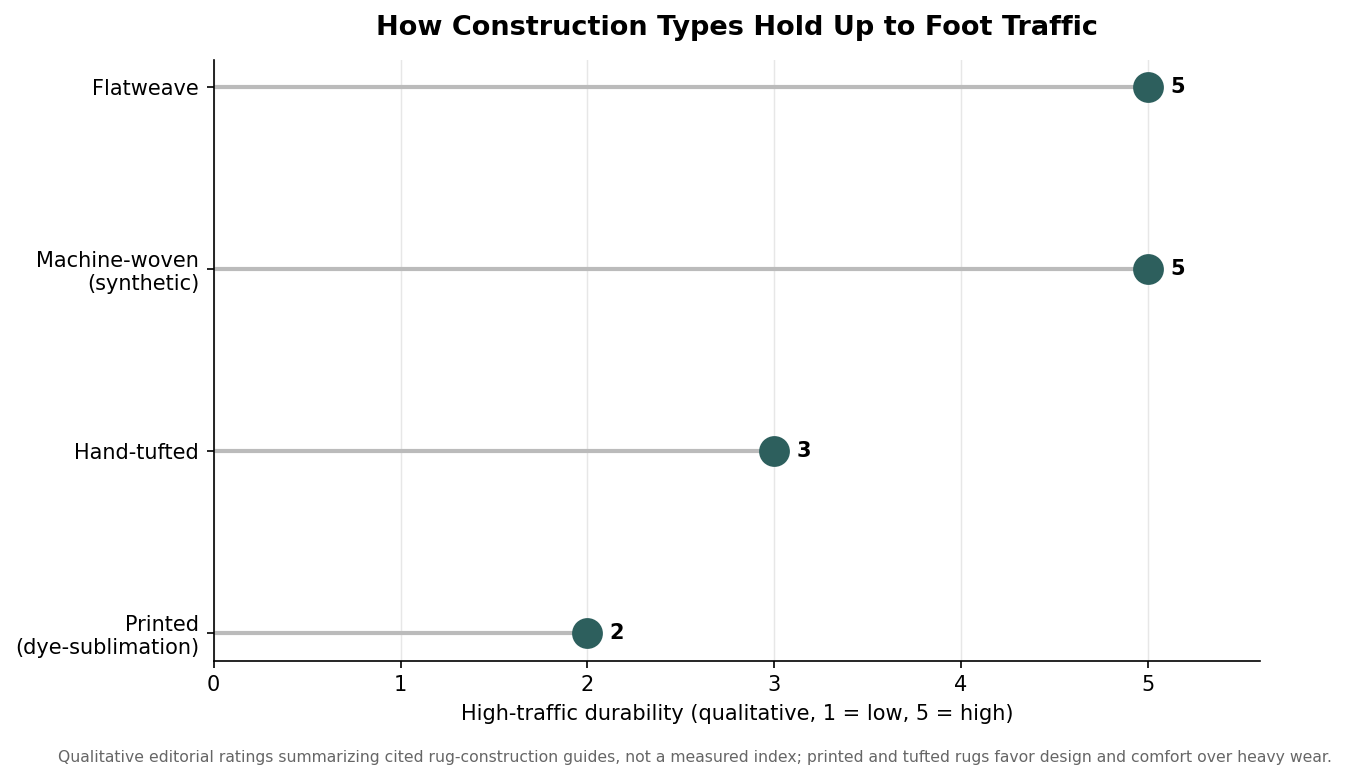
    Dot plot rating high-traffic durability of flatweave, machine-woven, hand-tufted, and printed rug constructions
    Flatweave and machine-woven synthetics take heavy traffic; tufted and printed rugs favor comfort and design.

    The ratings above are a qualitative summary of how these constructions are described across buying guides, not a laboratory measurement, so read them as direction rather than a scorecard. The useful takeaway is the ordering: flatweave and machine-woven synthetics take heavy traffic in stride, while tufted and printed rugs reward you with comfort or design detail in exchange for gentler placement.

    Fiber and design work with the construction, not against it

    Within those methods, the face fiber shifts the balance again. Synthetics such as polypropylene and nylon resist stains and moisture, which is why they dominate high-traffic and entry rugs and why they take printed graphics well. Natural fibers like wool feel richer and age gracefully but ask for more care and a gentler location. For a custom printed design, a synthetic pile is usually the right canvas because it holds saturated color and shrugs off spills, and a slightly lower pile keeps fine detail in the artwork from distorting as the fibers lean over time.

    Design choices can also hide wear. Busy patterns and mid-tone colors disguise footprints, crumbs, and the occasional stain far better than a solid pale field, which is worth remembering for a rug headed somewhere active. If you love a light, minimal look, put it where it will be admired rather than trafficked, and lean on a low pile and a stain-resistant synthetic to keep it looking clean.

    Working from the room to the order

    Put the pieces together and the specification writes itself. For an entry, hallway, or kitchen, order low pile in a flatweave or machine-woven synthetic, add a non-slip pad, and choose a pattern that forgives dirt. For a dining room, keep the pile low so chairs glide and cleaning stays easy. For a living room, a medium pile in a durable synthetic balances comfort against the traffic of a shared space. For a bedroom, this is where plush earns its place, and a hand-tufted or high-pile rug rewards bare feet. And when the whole point is a custom graphic, a printed synthetic rug in a lower pile gives you the color and detail you are after, placed somewhere the design leads and the footsteps are moderate. Decide the room first, let it set the pile and construction, and the rug you order will still look right long after the novelty of the design has settled in.
  • Custom Area Rug Materials: How to Match Fiber and Construction to the Room

    Custom Area Rug Materials: How to Match Fiber and Construction to the Room

    The fiber and the construction decide almost everything about a custom area rug: how sharp the printed color looks, how the surface feels underfoot, how well it shrugs off a spilled drink, and whether it still looks presentable after three winters of boots crossing it. Two rugs can share the same dimensions and the same artwork and behave completely differently in a room because one is a flat printed polyester and the other is a dense tufted nylon. This guide walks through the material choices behind a custom order so the rug you specify matches the room it has to survive.

    The four fibers that cover most custom orders

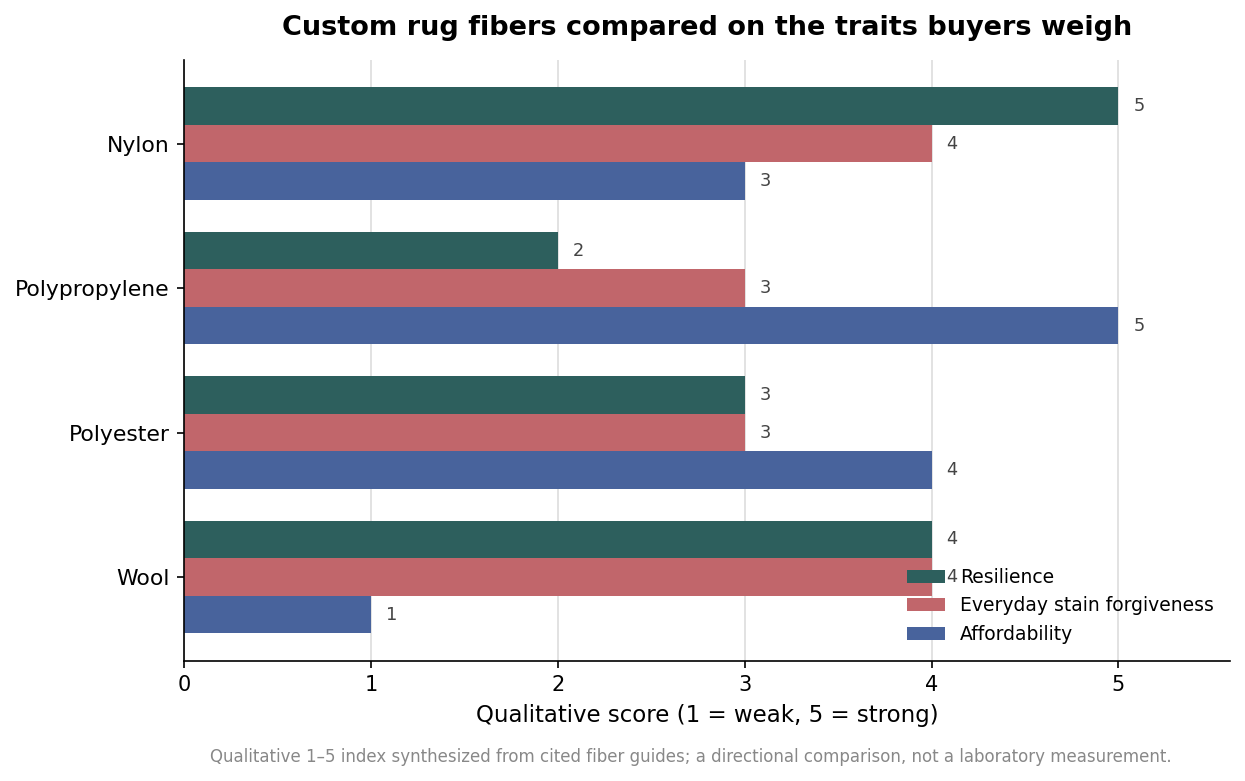
    Nylon is the workhorse. Among synthetic fibers it has the best resilience, meaning it springs back after a chair leg or a heavy foot compresses the pile, and it takes dye cleanly so custom colors stay crisp. It sits in the mid-to-premium price band and is the safe default for living rooms, hallways and commercial floors that see steady traffic. Polypropylene, also sold as olefin, is the budget champion and is usually solution-dyed, which makes it strongly fade-resistant in sunlight. It is excellent against water-based stains and many polypropylene rugs can be rinsed off outdoors, but the fiber is oleophilic: it absorbs oils, so a greasy or oil-based spill can set permanently. It also crushes and mats sooner than nylon, with consumer guides citing roughly three to five years of good looks in a busy room.

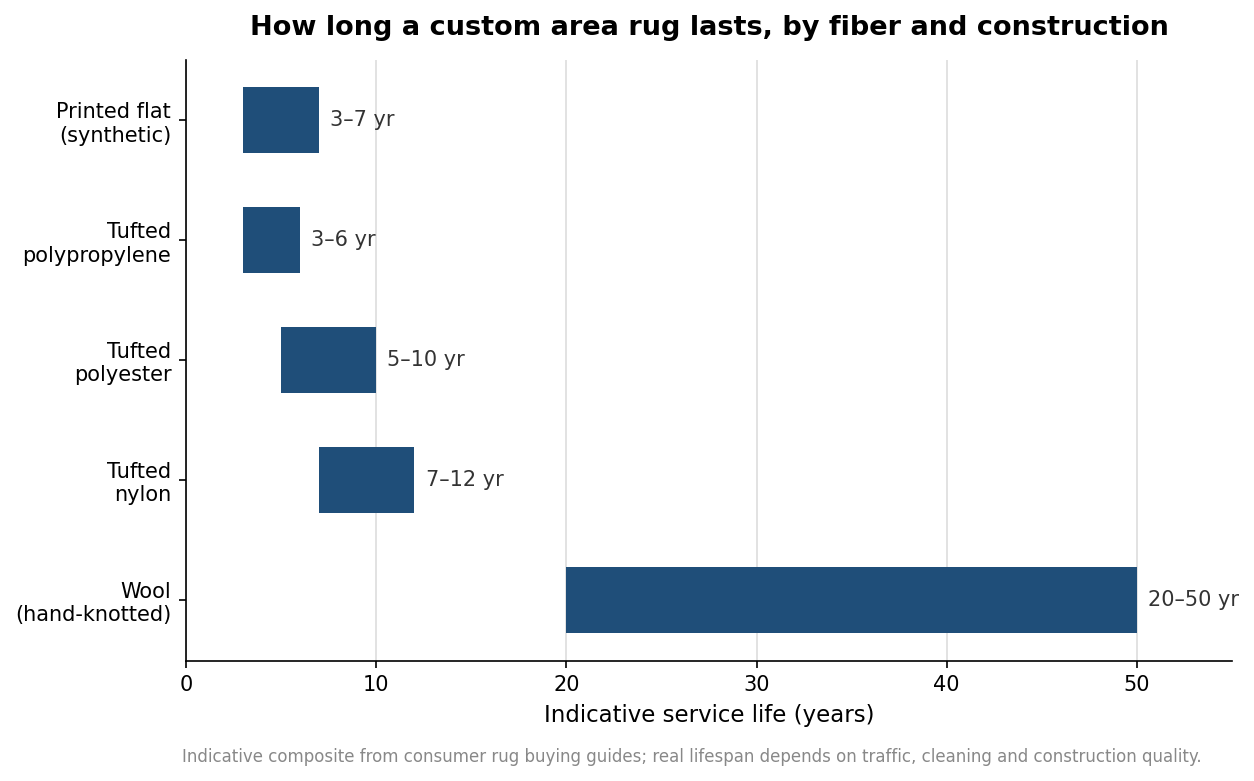
    Polyester (often PET, frequently from recycled bottles) gives a soft hand and vivid, photographic color, and it resists water-based staining well. Like polypropylene it dislikes oil, and it is less resilient than nylon, so it earns its keep in bedrooms and lower-traffic spaces rather than under a dining table used three times a day. Wool is the natural premium option. Its lanolin content gives genuine soil and stain resistance, it feels warm and plush, and a hand-knotted wool rug can last fifty years or more. The trade-offs are cost, an initial shedding period, and a preference for professional cleaning every one to three years.

    Grouped bar chart comparing nylon, polypropylene, polyester and wool on resilience, stain forgiveness and affordability
    Nylon leads on resilience, polypropylene on price, wool on feel and longevity — a directional comparison.

    Printed, tufted, or woven: construction changes everything

    Construction matters as much as fiber. A printed rug has its design digitally printed straight onto a base fabric, commonly a polyester or polypropylene woven, non-woven or felt cloth. The surface is flat with no pile, which makes printed rugs the most affordable and the fastest to produce, and it is the only method that reproduces full-color photographic artwork and fine gradients with total fidelity. The downsides are that dirt shows readily on a flat face and the print can wear or fade under heavy foot traffic. A tufted rug is made by punching yarn through a backing and locking it with latex or a secondary backing, giving a raised pile that hides dirt and feels plush; tufting works with wool or synthetic yarns and strikes a middle ground on cost. A woven rug, made on a loom, is the most durable and the most expensive, and it carries the longest lead time.

    Most everyday rugs, printed or tufted, are built to last somewhere in the five-to-ten-year range before they look tired, which is worth keeping in mind when you weigh a cheaper printed piece against a denser tufted one. If the rug exists mainly to carry a logo or a bold graphic for a booth, a showroom or a photo backdrop, a printed rug delivers the sharpest artwork for the least money. If it has to live under real furniture and real feet, pile construction earns its premium.

    Reading face weight, pile height, and density

    Face weight is the single number buyers ask about most. It is the weight of the pile yarn alone, measured in ounces per square yard and excluding the backing. As a rough benchmark, a residential rug in the forty-to-sixty ounce range is considered solid for high-traffic use. The important caveat is that face weight on its own does not guarantee quality: a heavy but loosely packed pile can crush faster than a lighter, denser one, so fiber type and density deserve equal weight in the decision. Pile height is the other lever. A low pile, under about a quarter inch, sheds crumbs and vacuums easily, sits flat so chairs slide, and holds up better in traffic; a taller plush pile feels cozier underfoot but traps more debris and mats sooner. Match the pile to the job rather than defaulting to the plushest option.

    Horizontal range chart of indicative area rug service life by fiber and construction, from printed synthetics to hand-knotted wool
    Indicative service life by fiber and construction; wool hand-knotted rugs far outlast flat printed synthetics.

    Matching the material to the room

    Start from the setting, not the swatch. For an entryway, a hallway or a commercial floor, specify nylon with a low pile and a face weight toward the top of the range, or a solution-dyed polypropylene if easy washability outranks plushness. A living room rewards nylon or wool, which recover from furniture and feet while still feeling good barefoot. Under a dining table, where spills are a matter of when rather than if, a low-pile, stain-forgiving surface such as polypropylene or a flat printed weave that wipes clean will save you grief. For a patio, a garage gym, or a child’s playroom, polypropylene that you can hose off is hard to beat. A bedroom, which sees soft traffic, is where polyester or plush wool make the most sense. The point is to let the room’s traffic and spill risk pick the fiber, then choose construction and pile to suit.

    Budget, lead time, and where to spend

    Cost climbs in a predictable ladder. Printed synthetics sit at the bottom, tufted polyester next, tufted or woven nylon above that, and wool at the top. Those are relative bands rather than fixed prices, and any specific figure should be treated as indicative until a supplier quotes your exact size, fiber, and volume. Production time follows a similar logic: printed rugs turn fastest, tufted and woven goods take longer, and bulk custom orders are commonly quoted in weeks rather than days. Because rugs are cut and bound as textiles, finished dimensions typically carry a small tolerance, often on the order of one to two percent, so plan layouts with a little margin and confirm the exact tolerance before you order.

    The most useful way to spend is to put the budget where the wear is. For a high-traffic floor, invest in fiber and face weight and accept a simpler design; the rug’s job is to survive. For a branded or decorative piece that will not take a beating, spend on print quality instead, since a printed polyester rug gives you the cleanest graphics for the money. Decide what the rug must do first, and the material specification tends to choose itself.

  • Rug Edge Finishes Explained

    Nobody chooses a rug for its edge. Everybody notices a bad one, usually about two years in, when it starts lifting at a corner.

    Binding: tape, stitched through

    A woven cotton or linen tape is folded over the edge and stitched through the backing. It is clean, quick, and available in any width and color, which makes it the most flexible option in a scheme.

    A wide binding in a deliberately contrasting tone is the cheapest way to make a plain rug look designed. Ask for mitered corners — gathered corners are the giveaway of a rushed job.

    Serging: yarn, wrapped by hand

    Yarn is wrapped tightly around the edge by hand so there is no tape at all, just a dense rope of color that reads as part of the rug rather than an addition to it.

    It costs more and takes longer, and it is the finish on most rugs that look expensive in a photograph. On a curved or round rug it is the better choice, because tape has to be eased around a curve and serging simply follows it.

    Fringing: traditional, and a commitment

    Fringe is the extension of the warp threads on a traditional woven rug, and on a modern tufted rug it is added deliberately for that look. It reads antique and it suits some designs beautifully.

    It also needs combing straight after cleaning, and it is the part a vacuum eats. Choose it because you want it, not because it came with the picture.

    Glued and heat-sealed edges: avoid

    The cheapest finish bonds a tape on with adhesive or heat rather than stitching through. It looks identical on day one and it peels within a couple of years, usually taking a strip of pile with it.

    If a quote does not say how the edge is attached, that is worth asking about before anything else on the specification.

  • How to Size a Rug for a Room

    Almost every rug that looks wrong in a photograph is the right rug in the wrong size. There are three rules and they cover nearly every room.

    Sitting rooms: front legs on, at minimum

    The rug should be large enough that the front legs of every sofa and armchair in the grouping sit on it. That visually ties the furniture into one island and makes the room read as intentional.

    A rug small enough to float between the pieces does the opposite — it fragments the seating group and makes the whole room look smaller than it is. If the budget forces a choice, a larger rug in a cheaper construction beats a small rug in an expensive one.

    Dining rooms: add sixty centimeters on every side

    Measure the table, then add at least 60cm beyond every edge. That is the distance a chair travels when somebody pushes back to stand up, and it is what keeps the back legs on the rug instead of catching on the edge.

    This is also the room where a flatweave earns its place: no pile means chairs slide instead of snagging, and it is thin enough that nobody trips on the border.

    Halls and landings: full length, made to measure

    A runner that stops half a meter short of the end of a hall is noticed every single time somebody walks down it. This is the single most common reason people come to us, and it is the easiest thing to fix — measure the run and have it made.

    Leave roughly the same margin of floor on each side, typically 10 to 20cm, so the runner is centered rather than crowding one skirting board.

    Bedrooms: think about where your feet land

    The useful rug in a bedroom is the one that is underfoot when you get out of bed. Either run a large rug under the lower two-thirds of the bed so it extends past both sides, or use two runners along the sides.

    A rug that sits entirely under the bed is a rug nobody ever stands on, which rather defeats the purpose.

  • The Complete Buyer’s Guide to Custom Area Rugs

    A made-to-measure rug is a small number of decisions, and only one of them is the pattern.

    Work through them in this order. Each one narrows the next, and the last two are the ones that decide how the rug ages.

    Fiber first, and be honest about the room

    Wool is the benchmark. It recovers from compression, resists soiling because of the natural lanolin in the fiber, and takes dye with a depth synthetics do not reach. It is the right answer wherever the rug is meant to be noticed.

    Solution-dyed polypropylene is genuinely stain-resistant — the color is in the fiber, not on it — and it does not fade in sunlight. It is flatter and less pleasant underfoot, and it is the correct specification for a holiday let, a children’s room or a conservatory. Cotton sits between the two: light, washable, cool, and best in flatweaves.

    Then construction, which is mostly about thickness

    Hand-tufted has a pile and a canvas backing, and is the standard for a bespoke design. A flatweave has no pile at all — a few millimeters deep, reversible, and the only answer when a door has to clear the rug or dining chairs have to slide.

    Printed and machine-woven is where photographic artwork or a repeat order of twenty identical rugs takes you.

    Pile density is the specification nobody asks about

    Two rugs of the same height and fiber can differ enormously in how much yarn is packed into them, and that is what decides whether a traffic lane crushes flat in two years.

    For a hallway, a doorway or under a dining table, ask for a low, dense pile. For a bedroom or a reading corner, a longer looser pile is more comfortable and the traffic will never test it. A supplier who cannot tell you the density is selling you a picture.

    The edge decides how it ages

    A bound edge wraps woven tape around the rug and stitches through — clean, quick, and available in any width or contrasting color. A serged edge wraps yarn by hand with no tape at all, for a denser, more tailored finish.

    What to avoid is a glued or heat-sealed edge, which will peel within a couple of years and take a strip of pile with it. If a quote does not name the edge treatment, ask.

    Size it to the furniture, not to the floor

    In a sitting room, get at least the front legs of every seat onto the rug. A rug floating in the middle of a seating group makes the whole room read smaller and looks like an afterthought.

    Under a dining table, add 60cm beyond the table edge on every side, so a chair pulled out stays on the rug rather than catching on the edge. In a hall, run the runner to the actual length rather than stopping short.

    What to send when you ask for a quote

    Dimensions, a rough sketch with anything the rug has to work around, your fiber and construction preference if you have one, and a physical color reference in the post. That is enough for a scaled drawing and a real quote the same day.