The fiber and the construction decide almost everything about a custom area rug: how sharp the printed color looks, how the surface feels underfoot, how well it shrugs off a spilled drink, and whether it still looks presentable after three winters of boots crossing it. Two rugs can share the same dimensions and the same artwork and behave completely differently in a room because one is a flat printed polyester and the other is a dense tufted nylon. This guide walks through the material choices behind a custom order so the rug you specify matches the room it has to survive.
The four fibers that cover most custom orders
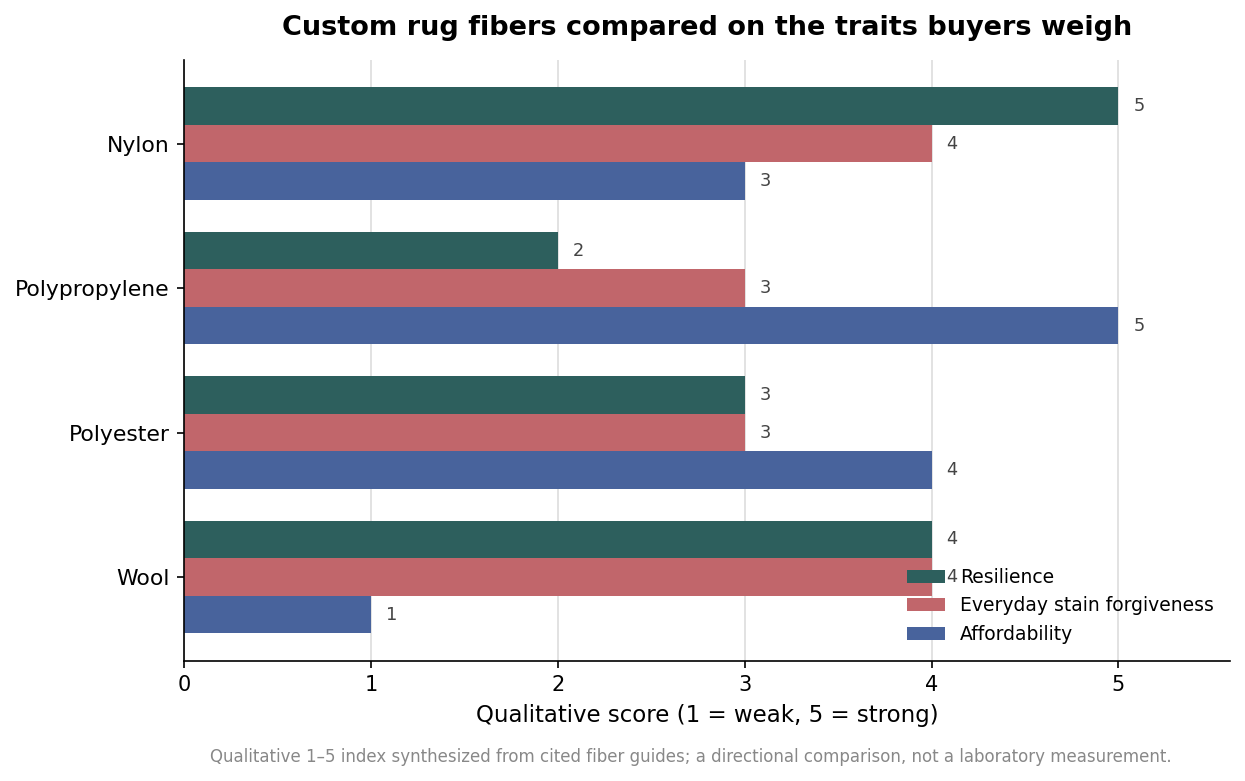
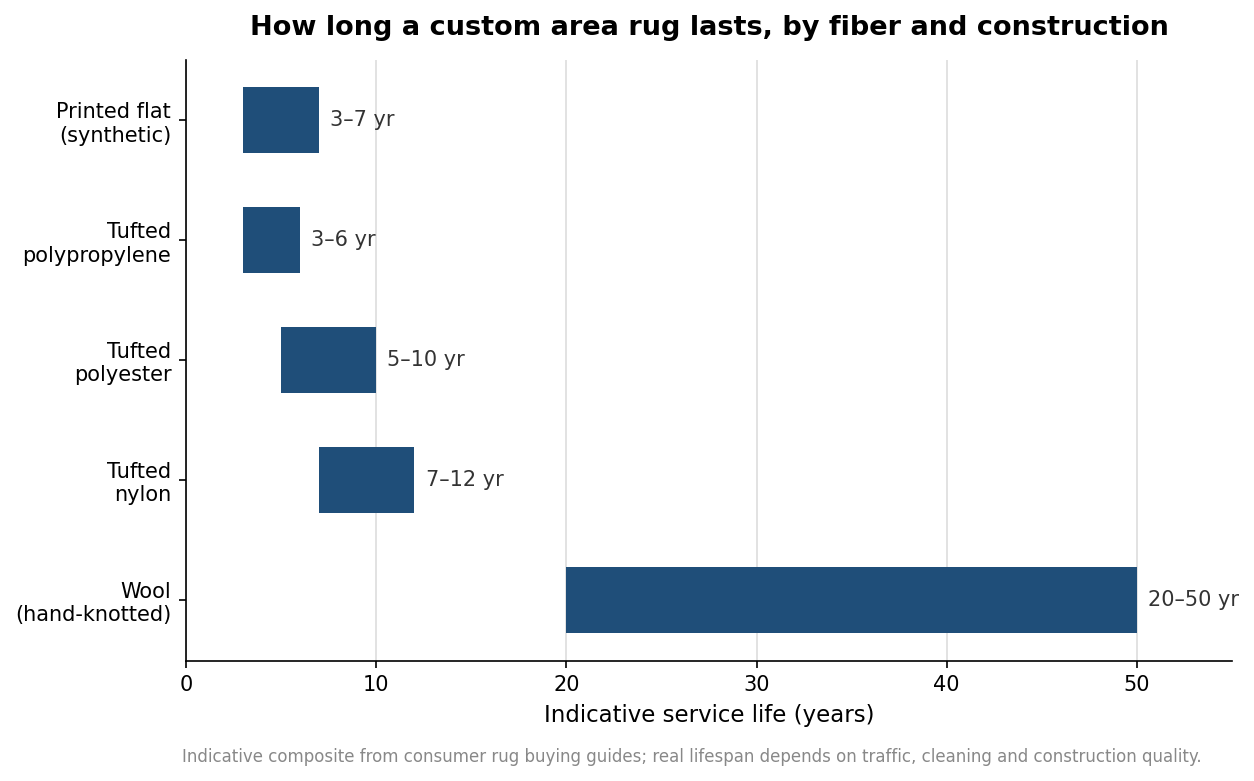
Nylon is the workhorse. Among synthetic fibers it has the best resilience, meaning it springs back after a chair leg or a heavy foot compresses the pile, and it takes dye cleanly so custom colors stay crisp. It sits in the mid-to-premium price band and is the safe default for living rooms, hallways and commercial floors that see steady traffic. Polypropylene, also sold as olefin, is the budget champion and is usually solution-dyed, which makes it strongly fade-resistant in sunlight. It is excellent against water-based stains and many polypropylene rugs can be rinsed off outdoors, but the fiber is oleophilic: it absorbs oils, so a greasy or oil-based spill can set permanently. It also crushes and mats sooner than nylon, with consumer guides citing roughly three to five years of good looks in a busy room.
Polyester (often PET, frequently from recycled bottles) gives a soft hand and vivid, photographic color, and it resists water-based staining well. Like polypropylene it dislikes oil, and it is less resilient than nylon, so it earns its keep in bedrooms and lower-traffic spaces rather than under a dining table used three times a day. Wool is the natural premium option. Its lanolin content gives genuine soil and stain resistance, it feels warm and plush, and a hand-knotted wool rug can last fifty years or more. The trade-offs are cost, an initial shedding period, and a preference for professional cleaning every one to three years.
Printed, tufted, or woven: construction changes everything
Construction matters as much as fiber. A printed rug has its design digitally printed straight onto a base fabric, commonly a polyester or polypropylene woven, non-woven or felt cloth. The surface is flat with no pile, which makes printed rugs the most affordable and the fastest to produce, and it is the only method that reproduces full-color photographic artwork and fine gradients with total fidelity. The downsides are that dirt shows readily on a flat face and the print can wear or fade under heavy foot traffic. A tufted rug is made by punching yarn through a backing and locking it with latex or a secondary backing, giving a raised pile that hides dirt and feels plush; tufting works with wool or synthetic yarns and strikes a middle ground on cost. A woven rug, made on a loom, is the most durable and the most expensive, and it carries the longest lead time.
Most everyday rugs, printed or tufted, are built to last somewhere in the five-to-ten-year range before they look tired, which is worth keeping in mind when you weigh a cheaper printed piece against a denser tufted one. If the rug exists mainly to carry a logo or a bold graphic for a booth, a showroom or a photo backdrop, a printed rug delivers the sharpest artwork for the least money. If it has to live under real furniture and real feet, pile construction earns its premium.
Reading face weight, pile height, and density
Face weight is the single number buyers ask about most. It is the weight of the pile yarn alone, measured in ounces per square yard and excluding the backing. As a rough benchmark, a residential rug in the forty-to-sixty ounce range is considered solid for high-traffic use. The important caveat is that face weight on its own does not guarantee quality: a heavy but loosely packed pile can crush faster than a lighter, denser one, so fiber type and density deserve equal weight in the decision. Pile height is the other lever. A low pile, under about a quarter inch, sheds crumbs and vacuums easily, sits flat so chairs slide, and holds up better in traffic; a taller plush pile feels cozier underfoot but traps more debris and mats sooner. Match the pile to the job rather than defaulting to the plushest option.
Matching the material to the room
Start from the setting, not the swatch. For an entryway, a hallway or a commercial floor, specify nylon with a low pile and a face weight toward the top of the range, or a solution-dyed polypropylene if easy washability outranks plushness. A living room rewards nylon or wool, which recover from furniture and feet while still feeling good barefoot. Under a dining table, where spills are a matter of when rather than if, a low-pile, stain-forgiving surface such as polypropylene or a flat printed weave that wipes clean will save you grief. For a patio, a garage gym, or a child’s playroom, polypropylene that you can hose off is hard to beat. A bedroom, which sees soft traffic, is where polyester or plush wool make the most sense. The point is to let the room’s traffic and spill risk pick the fiber, then choose construction and pile to suit.
Budget, lead time, and where to spend
Cost climbs in a predictable ladder. Printed synthetics sit at the bottom, tufted polyester next, tufted or woven nylon above that, and wool at the top. Those are relative bands rather than fixed prices, and any specific figure should be treated as indicative until a supplier quotes your exact size, fiber, and volume. Production time follows a similar logic: printed rugs turn fastest, tufted and woven goods take longer, and bulk custom orders are commonly quoted in weeks rather than days. Because rugs are cut and bound as textiles, finished dimensions typically carry a small tolerance, often on the order of one to two percent, so plan layouts with a little margin and confirm the exact tolerance before you order.
The most useful way to spend is to put the budget where the wear is. For a high-traffic floor, invest in fiber and face weight and accept a simpler design; the rug’s job is to survive. For a branded or decorative piece that will not take a beating, spend on print quality instead, since a printed polyester rug gives you the cleanest graphics for the money. Decide what the rug must do first, and the material specification tends to choose itself.